While Jason and the Argonauts is not famous for laughs, with The Othernauts Clare Pollard has delivered a funny and gripping take on the Greek myth to delight middle-grade readers
How do you solve a problem like Medea? It’s one of the reasons Clare Pollard believes Jason and the Argonauts is a story that hasn’t been retold for a young audience in a while. But it’s a challenge she decided to take on, in part because it began her lifelong fascination with the myths and legends of Ancient Greece. “I think for me the starting point was seeing the movie of Jason and the Argonauts when I was a kid, which is why the story means so much to me. I absolutely adored it.”
The result is The Othernauts, with adventure, characters to love and – it has to be said – a slew of epic jokes about the weirder aspects of the tale and the lives it describes. The time felt right because Clare Pollard has her own middle graders as inspiration. “I’ve got children who are nine and 12 so middle grade is right in the zone.” And there is, she admits, a little bit of their sibling dynamic in central characters Phoebe and (plot spoiler) her twin brother Perry.
This is an author who has worked across genres and age groups – from The Weather, a play that premiered at the Royal Court, to poetry, adult fiction and non-fiction, plus a new translation of Ovid’s Heroines that she toured as a one-woman show. “I’ve always love writing everything, really.”

Her book Fierce Bad Rabbits was an exploration of the sometimes dark and sinister elements of children’s stories. “I take children’s literature very seriously,” she says. “I think we should all take children’s literature seriously and think about what stories we’re telling them. These books completely shape our imagination and often shape our moral code, our sense of what’s possible in the world.” Now with two children of her own, she’s been reading a lot of middle-grade stuff and believes the biggest mistake a writer can make is to underestimate the audience. “Your storytelling needs to be just as good, your descriptions just as evocative, your characters just as rounded, your jokes just as witty.”
In The Othernauts, there’s no dumbing down in the language, and she shows the same respect for the wit of a child audience as an adult one, albeit with some thought about the grislier bits of Greek myths. “There is dark material in them that you have got to handle quite carefully. But I just love the idea that I’m telling a story to children that is a version of the same story told to children thousands of years ago. I find that just incredible,” she says. “I really love reinterpreting these myths and trying to make them relevant now.”
“I just love the idea that I’m telling a story to children that is a version of the same story told to children thousands of years ago”
Medea, that problem character, is handled rather beautifully. “I had quite good fun making her into a Goth teenage witch,” she says. From her first stomping and slamming entrance, because she’s taken a night off from the shrine (where she spends her time making potions and sun-drying shrews’ hearts), she’s riveting and ghastly in equal measure. As Phoebe puts it: ‘I thought she’d be cooler than this’.
The seriously cool character in The Othernauts is Phoebe, who is also incredibly funny. What’s not to love about a heroine who starts out telling us how deeply bored she is, with only a wicked stepmother and poisonous flowers for company on the dust-smothered and man-free island of Lemnos. She certainly doesn’t want to be a boy – having been educated in man hating since she was small – but she wouldn’t mind a change of scene.
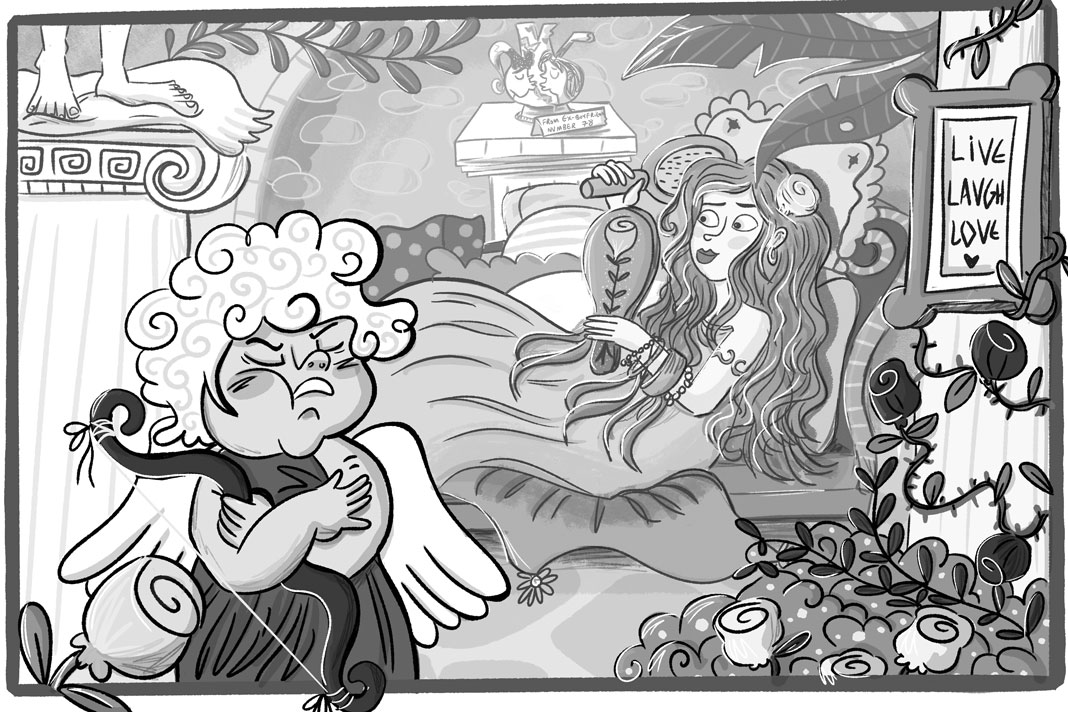
“I really wanted Phoebe to be that cynical, sarcastic character,” says Clare Pollard. Here, she admits she was influenced by her own children and the way they crack jokes – part of the shared language of home. “We all really love that deadpan humour.” She believes jokes are a hook for this age group, as long as they are actually funny, but she had the perfect judging panel of two. “Children are a particularly good audience to test jokes on. A joke will fall absolutely flat – it’s humbling,” she says.
There’s no doubt that audiences – boys and girls – are going to enjoy the polished humour in a story that treats a dark myth with lightness. Clare Pollard thinks the Greek myths endure because they have a plot that’s for everyone. “What’s so appealing about Greek myths – and the same is true of fairytales and a lot of these traditional tales – is that they weren’t aimed at children. There wasn’t such a thing as childhood in those days. It was literature for everybody.”
She’s looking forward to taking The Othernauts into schools – where she already does a lot of work with The Poetry Society – because she knows there’s a keen audience. “The couple of workshops I’ve done so far, it’s been hard to get a word in edgeways because children start giving me blow-by-blow accounts of The Odyssey – they get geeky about it!” She’d like the workshops to cover something else the Greek myths gave us. “I think the Greeks invented the shapes of stories – the stories that we still tell now,” she says. “One of the things I’m going to be asking is, how does a story work?”
The good news for readers who get behind Phoebe and Perry is that they ride off into the sunset in search of another adventure. The second book is well into production – no plot spoilers but expect monsters, a fiendish female and other typical hazards of ancient times. Clare Pollard is delighted because these are two characters she isn’t ready to let go of quite yet. “I’m fond of Phoebe and Perry. It’s really nice to take them forward into another story and see them grow up a bit.”

* The Othernauts, written by Clare Pollard and illustrated by Macha Yao, is out now (£7.99, Piccadilly Press).
Further reading: Ruth Lauren’s crime scene investigators
You may also like...