Scientific knowledge delivered early can become a thrilling journey for children as they discover the world through practical experiments and hands-on investigation. We speak to four prep schools to find out how they develop young scientists
James Allen’s Girls’ School
“Our science programme is designed to nurture curiosity, develop critical thinking, and build strong foundations in scientific understanding from the earliest years,” says Head of JAGS Junior School Victoria Goodson.
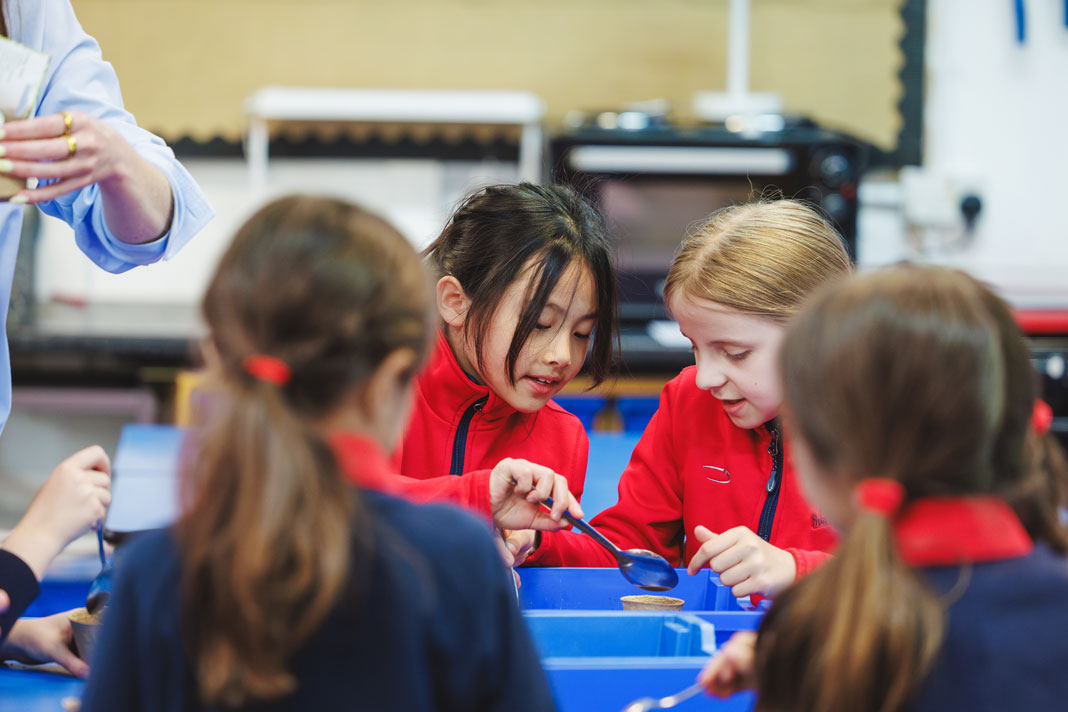
“We offer specialist science teaching from Year 3 onwards, with most lessons taking place in a fully equipped science classroom that allows pupils to engage in hands-on investigations using real scientific equipment.” This specialist setting and practical approach not only sparks enthusiasm but also helps pupils develop knowledge and enquiry skills that grow in complexity as they progress through the school.
Science teaching in Years 3 to 6 focuses on delivering a varied curriculum to spark curiosity and get children involved in practical (sometimes messy) experiments. “A standout feature at JAGS is our Forest School programme,” adds Victoria Goodson. “Our extensive grounds are a rare luxury so close to central London and include the Botany Gardens and The Copse, providing a rich environment where science is brought vividly to life.”
It’s a space where pupils investigate animal habitats, plant life cycles and see sustainability in action. Activities range from shelter building and knot tying to weaving with wool and twigs – helping children develop both scientific knowledge and essential life skills. Children explore biodiversity through bird and insect identification, investigate seasonal changes through tree identification and leaf studies, and examine plant life cycles by analysing seed pods. “Printmaking with leaves and organic matter from the forest floor adds a creative dimension, blending art with environmental science,” says Victoria Goodson. JAGS chooses this immersive approach to help reinforce key scientific concepts but also nurture a lasting appreciation of the interconnectedness of living things. “Forest School continues to be a highlight of the Prep experience, where curiosity thrives and learning is rooted in the real world.”
The school ensures that each year builds increasing depth and challenge. For example, in Year 3, pupils explore topics such as rocks, the human body, forces and magnets, and light, while developing skills such as making observations, recording data, and drawing conclusions. By Year 6, they are planning their own investigations, analysing results and using scientific evidence to support their ideas. They also tackle more advanced topics, such as chemical reactions, evolution and inheritance, and the circulatory system.
“The ‘Working Scientifically’ module is a constant throughout, anchoring the work we do and ensuring that pupils not only learn scientific facts but, crucially, also understand how science works. They learn to ask meaningful questions, test hypotheses, and communicate their findings clearly – essential skills for future study and for life beyond the classroom,” says Victoria Goodson.
Science happens outside the curriculum, with a wide range of extracurricular opportunities – from Eco and science clubs to national competitions, and CREST Awards. There’s a big focus on playing to individual strengths and learning needs to ensure all children feel inspired to take learning further. “Ultimately, our science programme is about more than simply recalling facts, it’s about genuinely nurturing inquisitive minds, building resilience, and empowering our young people to make sense of the world around them.”
James Allen’s Girls’ School jags.org.uk
The King Alfred School
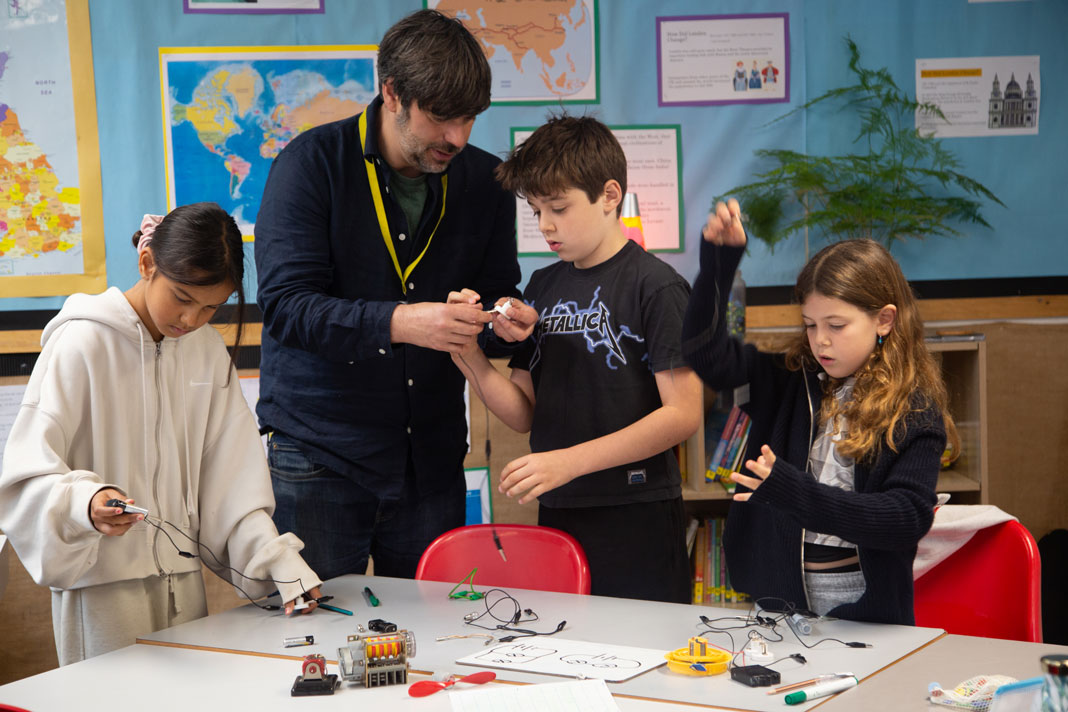
“The science programme in Lower School is woven within and around our five curriculum lenses: Being Human, Continuity and Change, Living Planet, Culture and Community and Communication,” says King Alfred School Head of Lower School Karen Thomas. “Enquiry based learning is our dominant pedagogy and this lends itself perfectly to developing children’s scientific thinking.”
There’s a stepped approach here that helps children put down solid foundations with the right approaches and then build knowledge in increments. “First we gain the necessary knowledge about a particular area of science and then we help the children to play with their new understandings to create and test the hypotheses they make,” adds Karen Thomas.
She says that since not too many people are inspired by worksheets, the aim is always to make early science explorations as hands-on and playful as possible to keep children engaged – and ensure they keep asking questions. ‘I wonder if’ and ‘show me how’ are often the starting points for science explorations at King Alfred. The school covers National Curriculum study areas – but is not limited by them. Karen Thomas says there’s a focus on “our continuum of science skills”. She adds that it’s important to equip the Lower School’s young scientists with the vocabulary, tools and methodology to take scientific exploration further and also think more deeply about where their discoveries could go next.
“We often draw from our community to bring another exciting dimension to our science offering, bringing in parents, friends, and teachers with a particular passion for science. We learn about scientists present and past, paying particular attention to challenge any existing stereotypes as we do so,” she says. Children are also tasked to think about what makes a great scientist – a good way to consider transferable skillsets and identify what makes a great learner.
There’s an annual STEM week involving the whole community. Visiting speakers run workshops and children (and their families) also get involved in a home-based project. “When these are brought into school, we organise for the children to visit one another’s classes and share what has been made.” Fun recent examples of this have included ‘Adaptation’, tasking children to make a model and fact file about either an animal they love or one they have invented. Children have also designed arcade games based on ‘Caine’s Arcade’ and been asked to come up with a whole new experiment and be prepared to share it with everyone. “These events create an extra buzz about science for children, teachers and parents alike,” adds Karen Thomas.
The school’s location, in leafy north-west London, also ensures science can head out of the classroom. As well as trips to the capital’s major and more local museums, outside space becomes a learning lab – especially useful for environmental science. The aim is to help children recognise both the beauty of the earth and the positive and negative impacts human development can have. “We hope that, by doing this, our scientists of the future will have a respect for the environment and will make ethical and planet-friendly decisions when they enter the workforce.”
The King Alfred School kingalfred.org.uk
Francis Holland Prep School
“At Francis Holland Prep, science is far more than a subject; it is a journey of discovery that we harness from the Early Years, evolving into a rigorous, specialist curriculum by Year 6,” says Deputy Head Andrew Hart. Over the course of the last academic year, the school has engaged in a comprehensive curriculum review, with a progressive approach to ensure clear pathways for deepening both understanding and skill in these formative years.
“From the outset, our pupils are immersed in hands-on science. In the Early Years, pupils explore through play, and we harness children’s natural capacity for experimentation, laying the foundations for deeper scientific thinking,” adds Andrew Hart. As they move through the school, the curriculum becomes increasingly specialised, introducing key concepts in biology, chemistry and physics, while nurturing those same analytical thinking and investigative skills first sparked through play. “By Year 6, pupils are confidently engaging with complex ideas and applying their knowledge in meaningful contexts.”
Project-based learning and citizen science are central to the approach here. “Through headline initiatives, including Enterprise Club, Eco Warriors and Sustainability Champions, pupils lead investigations into real-world issues.” These range from climate change to biodiversity and Francis Holland Prep pupils get busy doing everything from designing eco-friendly inventions to promoting sustainable practices and analysing environmental data. “Our children take ownership of their learning and see the impact of their scientific achievements, both at school and out in the wider community,” says Andrew Hart.
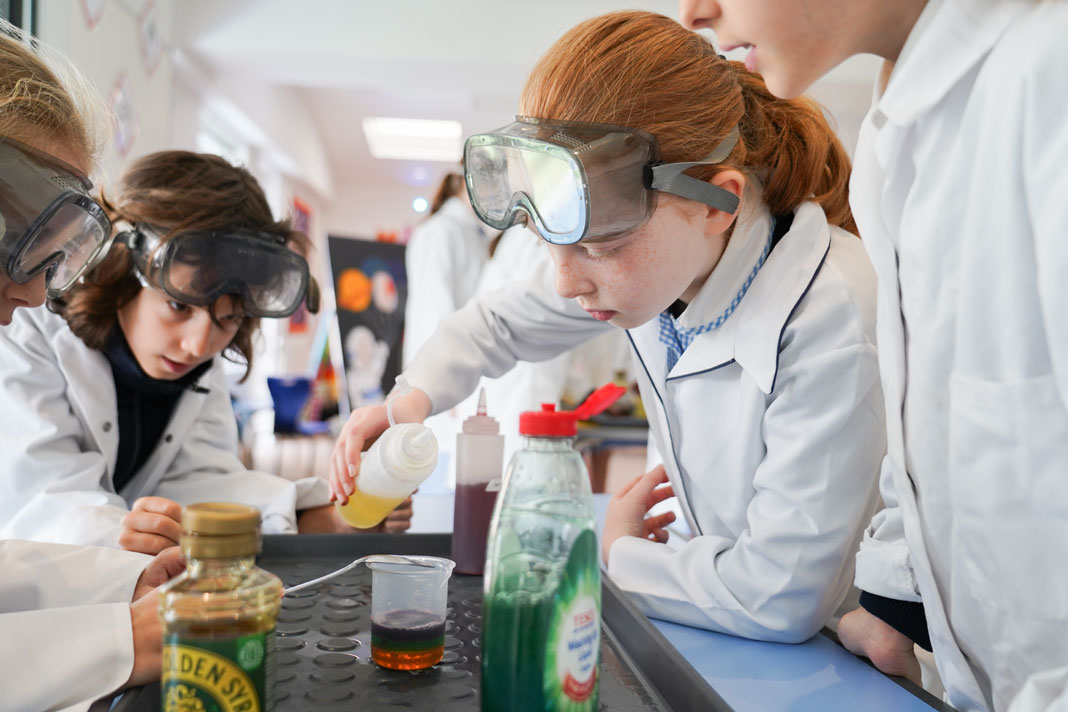
Practical science is the cornerstone and is designed to surprise and inspire. “Pupils create edible water pods, build solar ovens and make glow-in-the-dark slime. They test bioplastics, design magnetic mazes and monitor air quality, linking science with sustainability and innovation.” He adds that these hands-on experiences help to embed scientific thinking – so that pupils see science as a subject they can achieve in and lead in. “Our STEAM Room (Science, Technology, Engineering, Arts and Maths) is alive with excitement. These immersive experiences not only reinforce key concepts but also create lasting memories that fuel a lifelong love of learning.”
Francis Holland Prep’s Chelsea location means a wealth of opportunities right on the doorstep for enrichment. Trips are an intrinsic element the curriculum and, with the Science Museum (a 15-minute walk), Natural History Museum and so many other national treasures so close, learning is brought to life as part of the school day. There are regular visiting speakers from across the science and innovation sectors – many drawn from the school community – and this connects classroom learning to the wider world and helps pupils see themselves as future scientists and changemakers.
The co-curricular provision has expanded significantly recently, with dedicated Coding and Robotics clubs providing opportunities to explore the intersections of science and technology. Further Inventors and Practical Science clubs develop creativity and problem-solving skills. All age groups are welcomed, giving valuable space for experimentation and collaboration on challenges. “Ultimately, our STEAM programmes provide pupils with the knowledge, curiosity and confidence to explore, innovate and never stop questioning.” says Andrew Hart. “Our pupils are equipped with a lifelong passion for science and an appreciation of their power to change the world.”
Francis Holland Prep School francishollandprep.org.uk
Ballard School
At Ballard School, pupils are encouraged to think like scientists from the earliest years. “We start with the end in mind – we achieve exceptional outcomes in GCSE,” says Ballard Head of Science Aaron Markar. “However, it’s not all about grades, pupils leave with a real-world understanding of science and its practical applications. This journey often begins early in Prep, where access to specialist science teaching lays the foundation for future success and a love of the subject.”
The school’s approach works to make science accessible but also build ambition and enthusiasm. “We are about making science accessible for all children while retaining the challenge, excitement and inspiration. Early training to ‘think like a scientist’ is combined with very hands-on practical science – learning how to use the scientific process to test, investigate and experiment,” adds Aaron Markar.
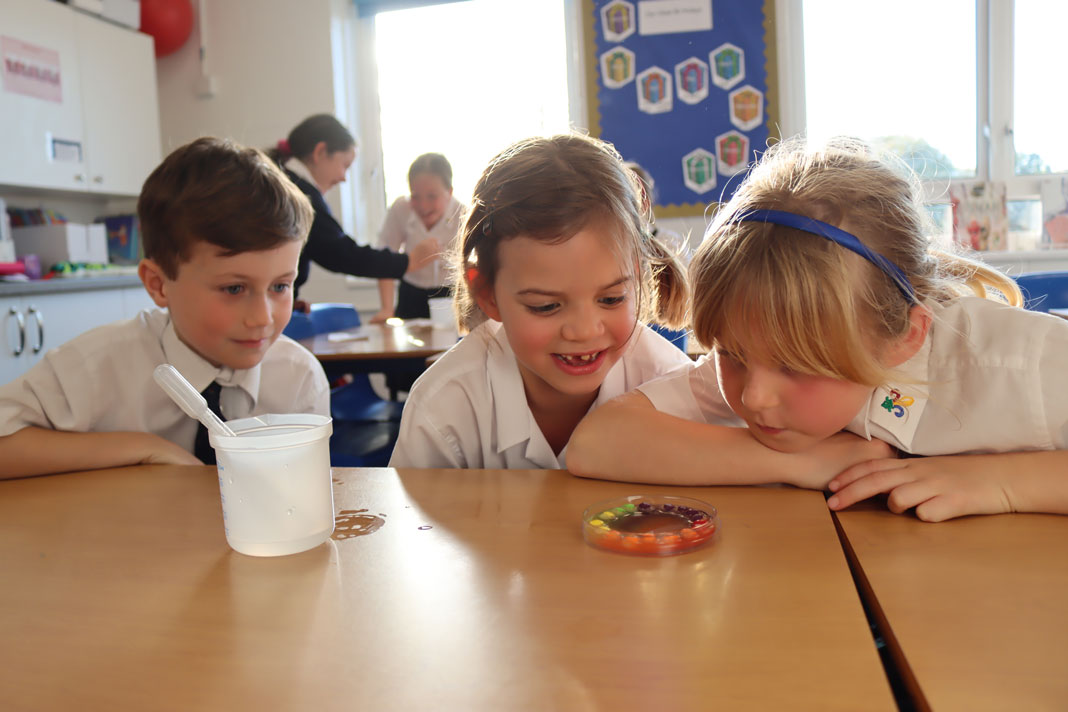
Specialist teaching begins early, with a strong emphasis on practical work and scientific thinking. “Building on basic skills each year and using correct vocabulary from a young age ensures that science is always relevant and engaging,” says Ballard Prep Science Teacher Abigail Greaves. And this provision extends well beyond the classroom, with science clubs across both the Prep and Senior schools. “Pupils get to experiment, use equipment and participate in science activities far beyond our already broad curriculum. Science club favourites include copper plating nails, chromatography, and secret writing with invisible inks.”
As you’d expect, given Ballard’s wonderful Hampshire location, conservation and environmental stewardship are central elements of science teaching, with pupils regularly engaging in real-world eco initiatives. “As an Eco School, we make full use of our site – grasslands, multiple Forest School areas, our stream and Ballard Pond – to bring ecology to life. Pupils can ‘pop’ outside and have lessons out of the labs, and we’ve noticed an increasing affinity for the outdoors and the ecological aspects of the curriculum,” says Aaron Markar.
Project-based learning is another key strand, using the CREST Award framework to help children develop both their knowledge and research skills. “In Year 7, pupils take on a ‘Why’ project – choosing a question to research and present at a mini science fair,” says Abigail Greaves. And, like all great science teachers and communicators, she and the rest of the Ballard science team relish creating memorable moments. “Pupils always love anything with flames, popping and fizzing.
“We often use food in experiments to bring complex ideas to life – jelly models of cells, Oreo biscuits for moon phases, fruit as planets to show size and distance in space. We measure crater size with marbles and sand, simulate digestion using tights, and create ‘alien soup’ to consolidate knowledge of separating mixtures.” Pupils also have highly interactive lessons on the heart and circulatory system – including dissecting a pig’s heart with string to trace its chambers
Plenty more real-world science is provided with trips to local museums and multiple Science Week events – workshops, science domes and viewing NASA’s moon rock collection among them. Guest lectures – including from alumni working in the science and technology industries – help pupils see the future possibilities that could await them. “It’s often said that ‘you have to see it to be it’ – and we take that seriously,” says Ballard’s Aaron Markar.
Ballard School ballardschool.co.uk
Further reading: Super science – how schools bring STEM subjects to life
You may also like...