Becoming a children’s author in your 20s is no mean feat, but Will Hamilton-Davies honed his ear for writing as a reader of stories, and kept on going until that grand plan was realised
Any author can tell you that finding your writing voice is the first hill to climb, and the second is finding an agent and publisher to believe in you. Will Hamilton-Davies has achieved all three things, still in his mid 20s. He is modest about it. “I should say, a lot of stars had to align for The Mole And The Mound to get published,” he says.
This is actually his second book. His first was self-published – and pretty much self-distributed – after a crowdfunding round at the grand old age of 22. He recalls standing in a cheese shop trying to persuade them to put a poster about the book in their window, and then being amazed when they actually said yes.
After that came what he thinks of as his really lucky moment. “I had already sold several thousands copies of The Shrew With The Flu (more or less by hand), when I entered The Mole And The Mound into my first competition, and, by some miracle, got shortlisted.” This then led on to offers from publishers and he found his agent. “By another stroke of fortune, Post Wave Children’s Books was on the hunt,” he adds. “And the rest was history.”
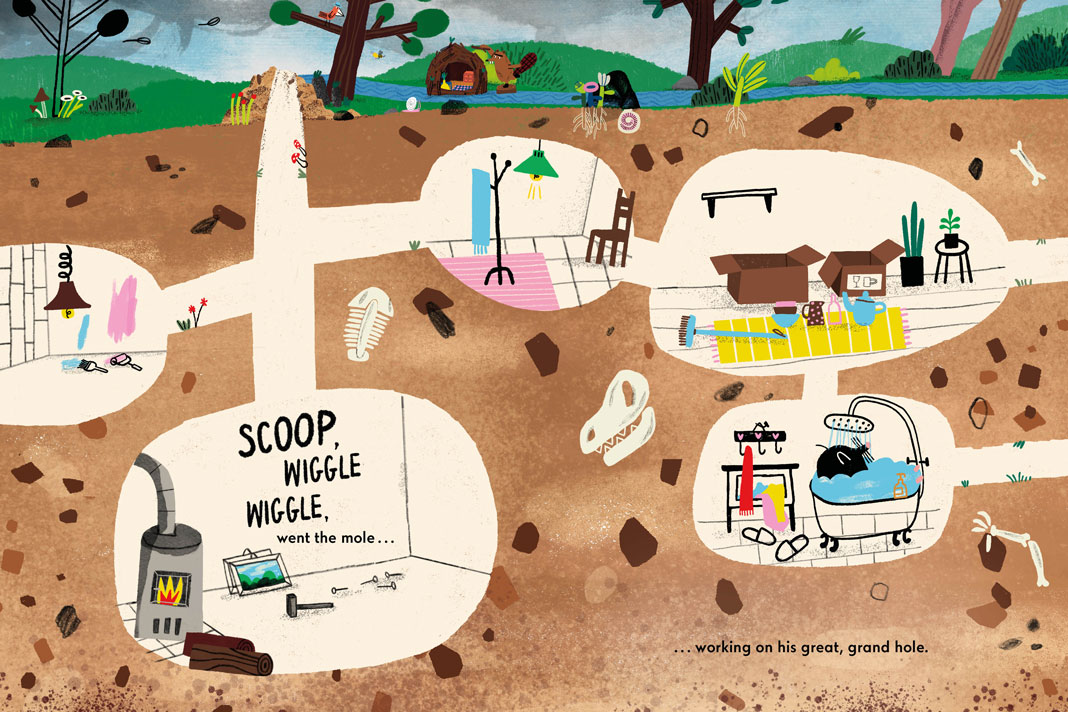
His second book is an endearing tale about a most determined mole constructing a place underground he can call his own. His friends, Bird, Beaver and Bee, can’t see what’s under this muddy mound and show off their superior housebuilding techniques. It’s only when a huge storm breaks, and shatters their nest, lodge and hive that they venture down Mole’s ‘great, grand hole’ to seek shelter – and find a veritable des res, full of sophisticated home comforts.
As with any good picture book, the illustrations share in telling the story. Will Hamilton-Davies worked very closely with illustrator Kasia Fryza to capture both the characters and the amazing home underground – a delightful reveal for young readers. “Mole’s ever-expanding system of tunnels – complete with home-gym, kitchen and bathroom – is quite exquisite, isn’t it!” he says.
The fact that Will Hamilton-Davies gravitated towards writing so early is surprising when you consider he was a reluctant reader as a child. He says this came down to lack of confidence. “My reluctance to read was more of a symptom of a lack of confidence and a fear of competing with other (much more capable) readers. A more confident child would probably have channelled their curiosity towards the one place known for being great at answering questions – books,” he says. It has had a lasting impact. “I’m always thinking about how I can help readers solidify a sense of confidence, as it’s confidence that creates children capable of picking up books and using them to get from A to B.”
Another vital aspect of Will Hamilton-Davies’ journey as a writer came from his family. Growing up in a village outside Bristol he was the middle of three boys. Then, just around his teens, the family dynamic shifted. Another brother and two sisters came along – so he was now one of six. “It was reading those three much younger siblings picture books at bedtime that really opened me up to how incredible they are at packaging up the world and helping you understand quite complicated ideas in really simple ways.”
This fired up an idea of becoming a writer. His stepmother was the first to encourage him to give it a try. Then, while he was studying journalism at Newcastle University, a “formidable” retired primary school teacher – his best friend’s grandmother – told him he had something and gave him further encouragement to keep going.
Will Hamilton-Davies credits his siblings for shaping his journey, too. “It certainly means I’ve read a lot of picture books,” he says. “I can say that I often think about my siblings when I’m writing stories.” And the whole family have been invaluable supports as ‘critical readers’ – even down to the science behind the story. “My youngest brother spotted an error in the way I referenced the construction of Beaver’s lodge in The Mole And The Mound, which led me to reword a section to make it more scientifically plausible.”
He likes to write in rhyme, and has thought a lot about why this is so effective for picture-book audiences. “Rhyme is a pattern that we can all get on board with, that kind of tells us what is going to happen next with the words in the story,” he says. “We can start guessing at what words are coming next, and we can start to be an active participant in the story. The flipside of that is that, because it is also a little bit more predictable and it has boundaries in a way that a prose picture book might not have, it makes it feel a little bit safer.”
Rather like Mole in this story working on his ‘great, grand hole’, Will Hamilton-Davies has put his head down, honed his skills, and shown how persistence can lead to grand results. “It does feel like a big achievement but also it feels like that is totally down to having other brothers and sisters and people around me that have been really encouraging since the start.
“What I’ve found is that the more passionate you are about something and the more willing you are to go out into the world and talk to people about those ideas, or those things that you’ve created, the more people are actually willing to support you.”
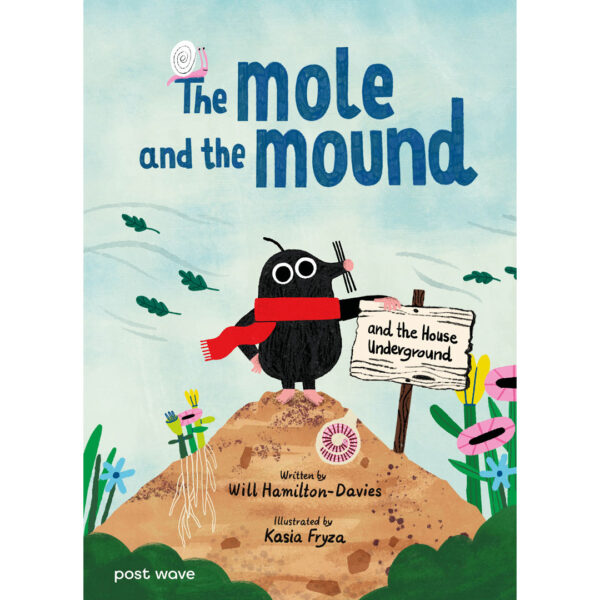
* The Mole And the Mound And The House Underground, written by Will Hamilton-Davies and illustrated by Kasia Fryza, is out now in both paperback and hardback (Post Wave, from £7.99).
Further reading: Space hero – John Chapman’s epic adventure
You may also like...