Tricia Rawlingson Plant, Founding Director of Mill on the Brue on the evolution of this Somerset outdoor education centre and its profound impact on visitors and natural landscape
Over 40 years ago, a Victorian house and barn with 13 acres of fields and river valley were purchased with the intention of turning it into an outdoor activity centre. At the time, it was advertised as a nine-hole golf course but presented as chemically sprayed land – a green ‘desert’ with little wildlife, few trees and no hedgerows.
Now, all these years on, and with more land increasing the acreage to 25, Mill on the Brue Outdoor Activity Centre has been transformed into a beautiful and flourishing haven. With over 7,500 trees, hundreds of metres of hedgerows, organically grown flower gardens and large vegetable beds, the wildlife has returned.
We have deer, badgers, foxes, squirrels, bats, slow worms, grass snakes and many species of birds – including buzzards and woodpeckers, house martins and swallows. There are insects such as solitary bees, the rugged oil beetle plus many wildflowers and plants.
Our aim has always been for children and adults alike to experience nature which they can appreciate and learn from. Any building work undertaken has the environment very much in mind. This is reflected in materials used for insulation and heating and with rainwater harvesting, a 49kw solar array and solar and thermal on all buildings.
Additionally, we have a food composter for any leftovers. This is eventually used as compost on the vegetables and fruit which are organically grown for our customers. This environmental ethos is a way of life, and we share Mill on the Brue with resident chickens, goats, pigs, sheep, a donkey and Shetland pony, bees – and our centre’s two cats.
Our major customers are school groups, usually primary in Years 5 and 6, who stay for either residential or day trips. We also welcome adult apprentices who come with their companies.
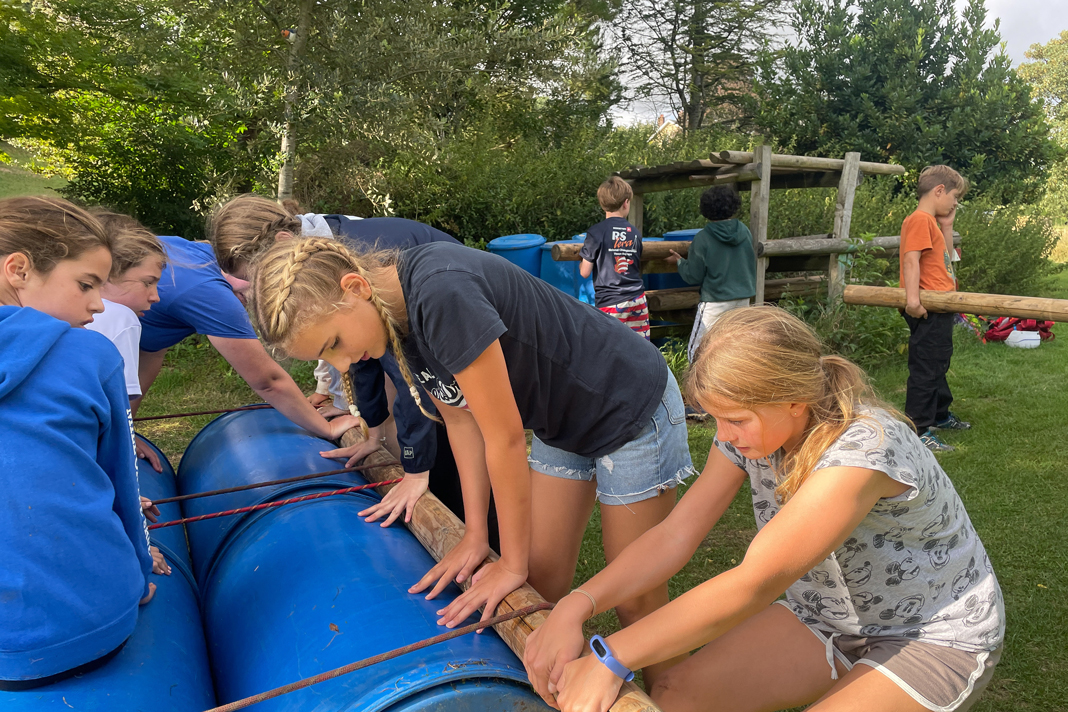
There has been much research to prove that experiencing nature in the outdoors has huge benefits in terms of mental health. Our many fun and challenging activities can also contribute to feelings of achievement, self-worth and satisfaction. They also build students’ understanding of how teams work, and the vital importance of communication.
For our young visitors, this is experiential learning at its best – whether this is being encouraged by your team mates to go that metre further on the high ropes, learning how vegetables are grown, abseiling down a tower, lighting a fire, or solving a problem which at first seemed overwhelming. We believe reviewing by the group at the completion of a task is vital because so many learning points are revealed. And sometimes participants experience failure, which again furthers their learning and understanding of themselves and others.
Children are able to do so much more than we adults often expect – as long as they are given the opportunity. They show determination and resilience whatever the weather, unexpected leaders emerge and, after a while, the teams begin to work together. The experience they have here at our centre becomes a lifelong lesson.
Many children who visit us from more deprived areas have never been in the countryside before. They have never stroked a sheep, sat by an open fire or contributed to solving a task as a valued member of a team. The activities are exciting and varied – from high ropes and abseiling to canoeing and archery. But it is what the children experience themselves which can be life changing. Many who come to us have little confidence. They may find school difficult, have few social skills and no real understanding of nature. If you have never achieved, there is no feeling of self-worth.
And the results? The children change over their stay with us. They become more responsive, resilient and enthusiastic. They gain understanding of the environmental aspects of our work and what they can do themselves to change attitudes. They leave as our ambassadors, returning home ready to educate family and friends.
Mill on the Brue millonthebrue.co.uk
Further reading: Outdoor time – why school gardens are so important for wellbeing
You may also like...