Bringing live music making back into schools is a mission for Restore the Music, and it has plenty of proof of the impact on student outcomes
Watch any toddler take to the dance floor or teenage band in rehearsal and you just know this brings something special, something beyond the immediacy of notes and rhythms. But the sad fact is that there is a severe shortage of music making in many schools, making teaching music almost impossible. In some, they lack even the basic resources for engagement.
Restore the Music has been on a mission, since 2013, to deliver the tools and the inspiration to redress that – focusing on some of the most music-depleted parts of the country. The first pilot project was, says CEO Polly Stepan, a wake-up call for her on how bad things were. “We hadn’t actually realised the extent of the problem – we literally had no idea,” she says. She grew up enjoying the benefits of a full musical education at Wimbledon High School. “There were no limits to the musical opportunities that I could access.” She studied piano and clarinet and enjoyed orchestra and choir tours. In common with most school children of her generation, she saw music as a birthright.

After a first career as a commodity broker, she stepped back to raise her twin children and, when she began to think of what to do next, it was a colleague – knowing her love of music – who pointed out the huge problem in schools. “Our model is so apt for today,” she says. “Increasingly, we need a language that all young people can speak, that everybody can access, that unifies, that brings harmony and delivers all sorts of skills.”
Restore the Music’s work is focused on schools in areas of high deprivation – 50% free school meals is the entry point, but it rises to 95% in some areas. Originally it was piloted and embedded in London, but as it has gained traction, it has expanded to Birmingham, Manchester and Newcastle.
The thinking here was that it makes more sense to deliver in areas of denser population, and strong musical heritage. “It’s much more sensible to build hubs within the cities where you have a denser footprint and the impact of the investment within these schools is far greater,” says Polly Stepan. “And schools then start to collaborate.”

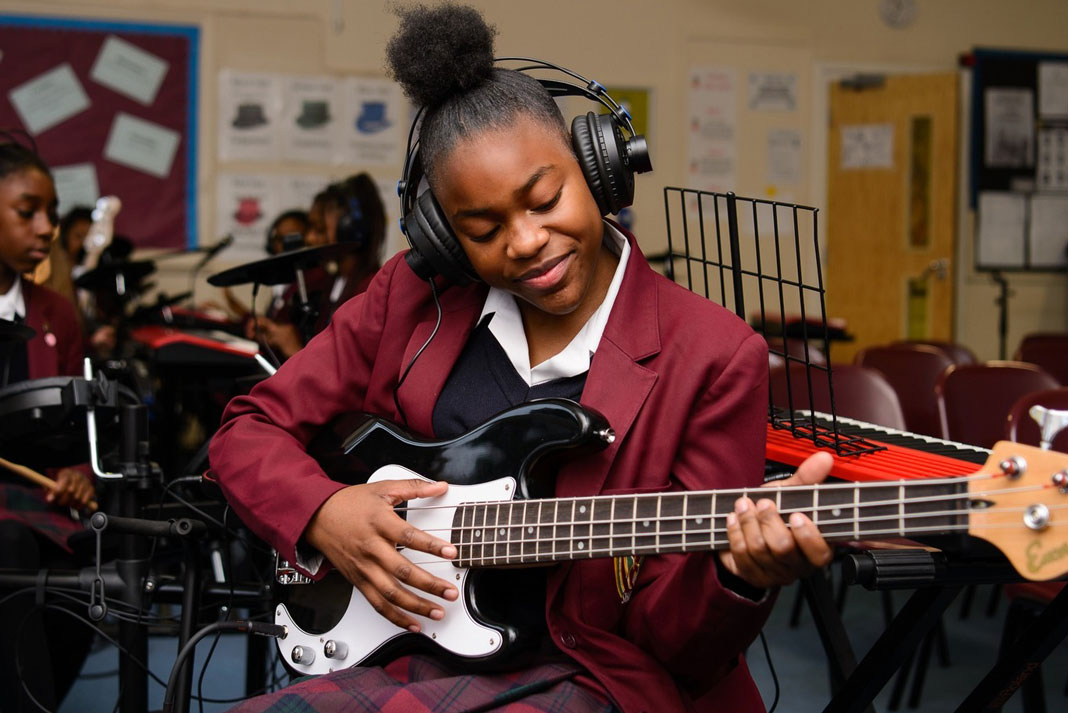
When schools start working with Restore the Music, they get an initial package of musical instruments and resources. From there, they can come back and request specialist instruments and support – for instance for a brass or jazz band. “We’ve delivered just about every musical instrument there is,” she says. The impact of tapping into local heritage and children’s own cultural heritage and interests can be immense. From brass to steel pan bands to gospel choirs – there are many inspiring music making collectives thanks to these packages.
Music technology is a big area where Restore the Music is supporting schools and it is working on some interesting data about the correlation between musical and numerical proficiency – especially in DJing, where beatmaking and ratioing (aka phrasing and beatmatching) are essential skills. “Often the brains of students drawn to DJing are also numerically highly proficient, which makes them hugely employable,” says Polly Stepan. “The problem for employers these days is that these are the children they can’t reach – often these are the students who are highly disengaged from education.”
“Often the brains of students drawn to DJing are also numerically highly proficient, which makes them hugely employable”
This is the overriding purpose of Restore the Music – helping students engage with education and achieve in school – and it has an impressive impact report, published last year, showing how the schools it supports have improved educational outcomes through music. “Our three goals are attendance, engagement and attainment. What we’re able to do is build those pathways, bring the children into education and the ripple effect of a positive music department across the whole school means that the levels across the whole school improve.”
Restore the Music’s work has drawn in generous supporters – from Warner Music, Universal Music and Sony Music Social Justice Fund to Bowers & Wilkins, The Childhood Trust and The Fishmongers Company. One of the very earliest to come on board was Steinway & Sons. That was the call Polly Stepan made when she had a blank notebook in front of her and the seeds of a plan to do something about music deprivation.

“It struck me that throughout my childhood playing piano – and I got to Diploma level – I always wanted a Steinway. That was my dream, a Baby Grand. I didn’t get it, but I thought if I wanted one that’s going to be other kids’ dream, too.”
Steinway couldn’t have been more open, or more generous in fuelling kids’ dreams and early and ongoing support has morphed into annual masterclasses for primary and secondary children, held at its Marylebone showroom. “Often these kids are learning on keyboards. I’ve got a kid in Greenwich who is learning Rachmaninoff on a keyboard,” she says. “They run round the showroom and they play every single piano as loud or as quiet as they want. And the Steinway people are relaxed and happy to see them enjoying themselves.”
A telling moment on the power of playing on proper instruments came at the end of one session when a little boy pointed at the price ticket on a Steinway and asked if it said £1,000. Polly Stepan helped him count the extra zeros. Enthusiasm undimmed, he said: “One day, I’m going to buy a Steinway”.
Alongside the generous corporate, charity and trust supporters, are Restore the Music’s active Ambassadors. Andrew Levy of The Brand New Heavies, Cary Powell of The Libertines and PMR Records’ A&R manager Sachin Johal have, she says, championed Restore the Music ever since they discovered its work.
There are also Junior Ambassadors paying it forward as mentors and examples to younger children. All are taking music to a higher level – and who knows where that will lead. “We’ve followed their journey and out of all the students, these have been the most engaged.” she says. “They represent everything I want Restore the Music to be.”

Thanks to the networks Restore the Music has developed, it has associations with cool venues – Band on the Wall in Manchester and The Lower Third in London, for example. It is always looking out for more partners – more people to join the bandwagon. “We’re always trying to find ways to collaborate with partners on initiatives that make sense and add another dimension,” she says. “We can’t do everything, but we can be a facilitator and an introducer as we’re regularly in touch with so many schools.”
Polly Stepan points to the value of music – in and of itself but also as teacher of so many transferable skills for life and career. It helps children build teamwork, listening skills and the ability to work at speed processing multiple strands of information. “Music was invaluable in my career,” she says. “And music brings joy.”
Restore the Music restorethemusicuk.com
Further reading: Emanuel School on a sound revolution
You may also like...