Gareth Parker-Jones, Head Master of Rugby School believes a liberal education remains our best bulwark against catastrophe
In 1920, H. G. Wells warned that: “Human history becomes more and more a race between education and catastrophe”. In 2026, that statement has lost none of its charge. Wells recognised that catastrophe – political, social or technological – is never far from the human story.
Our century carries its own palette of uncertainties – climate, geopolitics, and the unpredictable power of artificial intelligence.
Wells’s insight is twofold. The possibility of disaster is a constant companion. Education remains our most reliable defence. The question is: what kind of education equips young people not merely to survive in such a world, but to shape it for the better?
I believe the answer can only be a liberal education. A way of teaching that encourages a mindset that is curious rather than dogmatic; open rather than fearful; reflective rather than reactive.
Human beings are fallible. Improvement in any field comes not from certainty but from curiosity and compassion. We live at a time when certainty is shouted from every corner of public life in stark messages that brook no dissent.
In his 2019 book A Thousand Small Sanities, Adam Gopnik describes liberalism as a tradition that rejects cruelty, values sympathy, trusts in reasoned reform over rigid dogma, and believes in the power of open institutions to form free minds. This is what we pursue at Rugby School.
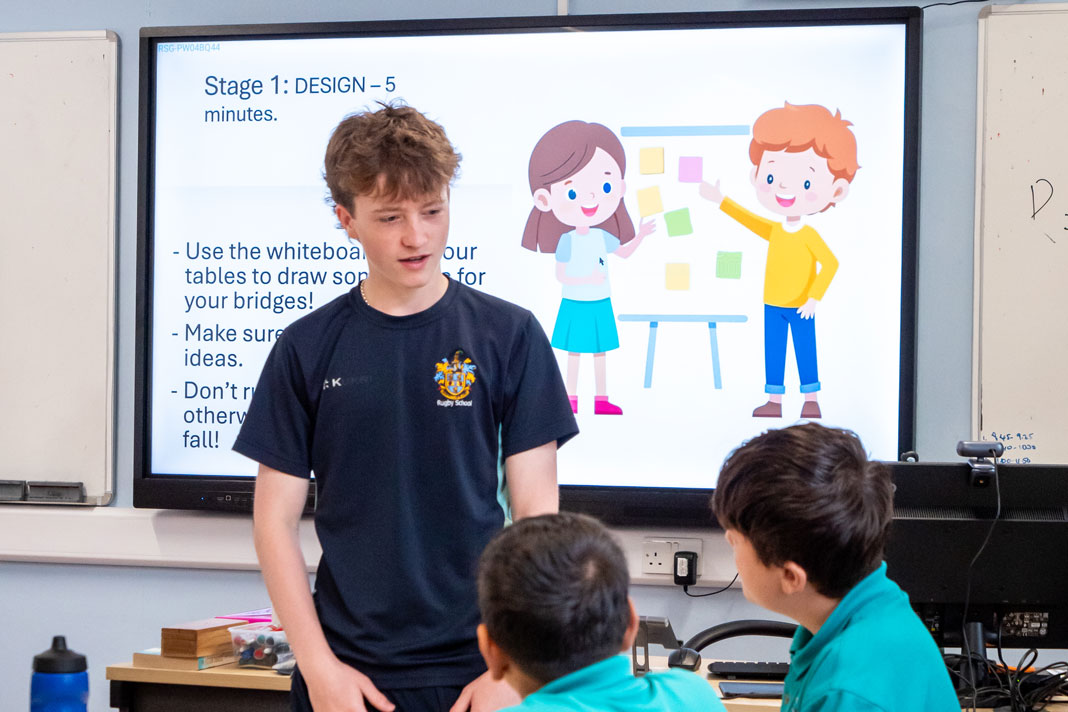
Our educational model is broad. We believe – and experience shows – that young people learn to think more clearly when exposed to a range of influences. A day at Rugby will include lessons that are discussions with teachers and fellow students based on independent study undertaken the night before. Human interaction really does accelerate learning.
There will also be activities outside the classroom, beyond the formal curriculum. Sport is timetabled with more than 25 options. Our musicians rehearse and perform at a level that demands discipline and creativity. Our drama productions bring together students in a shared endeavour that builds empathy and confidence. Our partnership programmes connect students with people of all ages and experiences. And, as well as A levels, we offer the International Baccalaureate Diploma Programme. All of this is made possible by being a full boarding school.
“A person whose mind is open, whose instincts are humane – that is the purpose of a liberal education”
Professor Francis’ recent curriculum and assessment review, and the Government’s response, recognised the significance of enrichment activities, including civil engagement, arts and culture, sport and physical activities, and the development of wider life skills. However, it was decided these should be extras rather than an integral part of an excellent education – a disappointing display of closed minds.
A liberal education is not about accumulating facts. It is about forming habits of mind: the ability to listen, to question, to weigh arguments, to imagine alternative possibilities. These habits matter because they encourage a humane way of thinking.
AI, for all its promise, risks narrowing human judgement unless it is paired with genuine critical thinking. Politics increasingly rewards outrage over reflection, and online life, too, often drives us into narrower identities and smaller worlds.
Wells feared that catastrophe might outrun education. Our best response is to provide an education that develops the whole person, building intellect, character and imagination. A person whose mind is open, whose instincts are humane – that is the purpose of a liberal education. This is what schools like Rugby aim to provide every day. And, in a world that feels increasingly brittle and dangerous, it is more important than ever.
Rugby School rugbyschool.co.uk
Further reading: Oakham School on wellbeing in action
You may also like...