The Head of St George’s Ascot Hannah Fox on why its students are thinking beyond the linear pathways of yesterday to secure futures in tomorrow’s world
Last year the Gatsby Benchmarks – the framework that underpins strong careers guidance in schools – celebrated their eleventh birthday. Their most recent review confirmed they remain at the heart of the Department for Education’s statutory guidance. For those of us working in schools, this is welcome recognition of the power that well-timed, personalised careers guidance can have.
As the 2025 report, Gatsby Good Career Guidance – The Next Ten Years, puts it: ‘When young people make supported and informed choices about their future study, training and work options, they are better able to maximise their talents and realise their ambitions’.
The truth is that education has always been about more than examination results. It is about preparing young people for a lifetime of learning, and for a future none of us can fully imagine. Knowledge, as the foundation of intellectual growth, matters enormously, but it must be coupled with the skills that help it take root and flourish: critical thinking, communication, collaboration, digital literacy, and the confidence to ask difficult questions.
In today’s AI-shaped world, adaptability and curiosity are as essential as any subject knowledge. That means schools should not be preparing students for one specific job, but instead equipping them with transferable skills and the resilience to thrive in a dynamic, often unpredictable marketplace.
A future-focused outlook also broadens higher education horizons. In our 21st century world, UK students can access universities across the globe and gain huge cultural wealth. I find in recent years, students are much more open to thinking outside the box and not automatically assuming UCAS is the only way forward.
Some degrees here no longer feel like a clear return on investment, while entry to medicine and its allied courses has become fiercely competitive. As a result, students are exploring Europe and further afield. IE University in Madrid is renowned for its global business programmes, Bocconi in Milan ranks among the best for economics and finance, and EHL in Lausanne is widely recognised as the world’s leading hospitality management school. All teach in English so are accessible to all pupils.
Many pupils are also considering the US, where liberal arts degrees and generous financial aid make study attractive. Others take up degree apprenticeships with companies such as Deloitte in accounting or Jaguar Land Rover (JLR) in engineering. This route is super competitive but means you have a guaranteed entry in that workplace, receive a healthy salary, acquire a degree and are saddled with no student debt. What’s not to like?
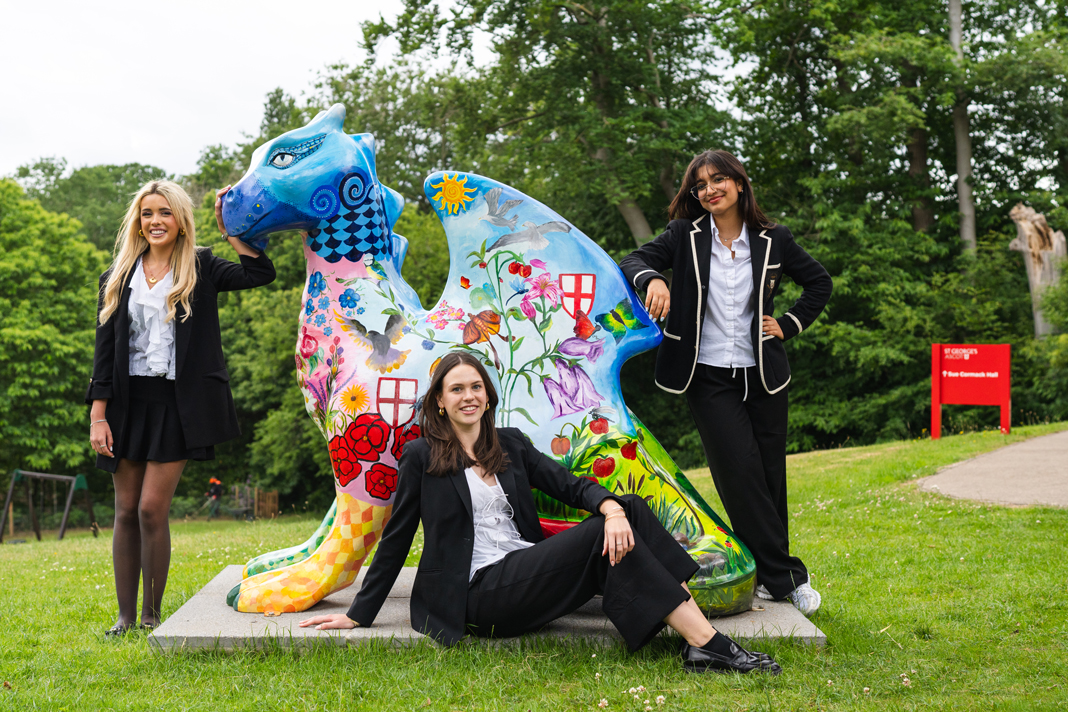
At St George’s Ascot, we see this shift first-hand and embrace it wholeheartedly. Our scale allows us to offer genuinely bespoke guidance, woven into the curriculum and led by a hugely experienced and passionate team. We work closely with the girls and parents, drawing on the experience of our Old Georgians alumnae who regularly return for ‘Working Lunches’ with the Sixth Form and to take part in our whole-school Careers Convention.
Later this term, The University Guys will be visiting with delegates from a dozen or more European universities to open girls’ eyes to options across the channel. Further on in the year, we shall hold a Degree Apprenticeship workshop. Alongside all of this, we ensure our girls are aware of the graduate marketplace and also the role of digital testing and gamification in recruitment. These opportunities bring real-world experience into the classroom and give pupils invaluable insights into how different paths can unfold. As part of our STEM Week each academic year, we invite some of our SGA Partners into school to talk to the girls about their chosen pathways and the roles they hold in business.
Academic breadth also plays a key role. We are proud that our pupils’ Extended Project Qualification (EPQ) results consistently place us in the top 3% nationally. The EPQ gives pupils the chance to explore an area of personal interest in real depth – whether that’s artificial intelligence, international law or the psychology of sport – and to develop research, presentation and critical thinking skills that universities and employers value highly. For many, it is the EPQ that sparks a lifelong interest or directly informs their future study and career choices.
Careers education is not a bolt-on but a continuous part of a pupil’s school life. It offers a set of touchpoints, conversations and experiences that give young people a clearer sense of who they are and what they might become. Crucially, we also prepare them for the realities of the graduate job market, and the likelihood that their working lives will be a patchwork of different roles rather than a single career.
I often say to pupils that education should not be seen as a simple, upward ladder with examinations as the rungs. Instead, it is more like a lattice: sometimes you climb upwards, sometimes across, sometimes in a more winding, wiggly direction. What matters most is that you keep climbing, and that you know there are many different ways to reach a fulfilling, happy and purposeful future.
St George’s Ascot stgeorges-ascot.org.uk
Further reading: Stand out tactics to build your CV
You may also like...