The Director of Student Recruitment and Admissions at TASIS England Joshua Clark considers how international schools use technology to turn learning into a personal journey for every student
Education has always evolved with technology – from the humble abacus and chalkboard to the rise of artificial intelligence (AI) and virtual reality (VR). Today, schools are focusing on how to provide personalized learning experiences while still maintaining rigorous academic standards.
For international schools, technology supports learning for students from diverse cultural, linguistic and academic backgrounds. International schools, with students from all over the world, must consider different levels of academic preparation, cultural perspectives and language proficiency levels. In these settings, personalization becomes a critical focus to ensure every learner is both challenged and supported. One student may arrive excelling in mathematics but still developing confidence in English. Another could come with strong language skills but have limited experience in inquiry-based science. Technology allows teachers to adapt accordingly. It also creates opportunities for students to work at their maximum level of interest, ability and pace.
Personalized learning gives more ownership, as students can shape their education through elective choices, interdisciplinary projects and inquiry-driven coursework. Technology also provides pathways to adapt pace or explore individual interests. Adaptive platforms adjust tasks to suit each learner’s level, while STEM labs, maker spaces and robotics programs encourage students to test ideas, design solutions, and express creativity in ways that align with their personal strengths.
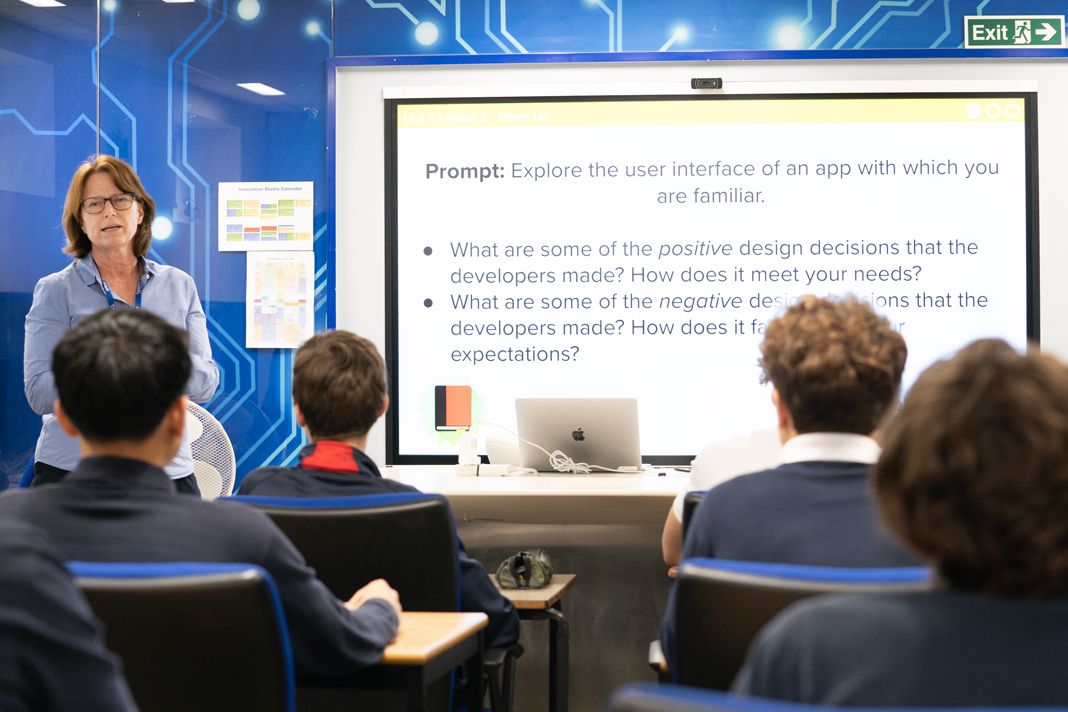
As personalization increases, the role of the teacher becomes more critical. Teachers curate resources and delivery methods to ensure learning standards are met while considering how to differentiate based on the learning opportunities and needs in the classroom. They guide students in using resources and offer feedback instantaneously as well as over time. Most importantly, teachers help students discern when technology should be used and when more traditional methods – discussion, reflection or hands-on activities – are more effective.
When technology is implemented thoughtfully, it can unlock amazing opportunities. Adaptive software provides tailored modules that help a student progress step by step, and exams can triangulate the edge of a student’s understanding. Robotics, coding and 3D printing allow students to be curious and develop essential problem-solving skills. Interactive displays make abstract concepts more concrete, helping all students engage more fully.
Technology is not a panacea and over-reliance on devices risks limiting human interaction. It has been found that excessive screen time can affect wellbeing. Students may have differing levels of prior exposure to technology, creating inequities in skill and confidence. Data privacy and ethical questions around AI demand careful consideration and implementation plans, too.
Every learning community must consider its own goals, culture, resources and needs. Clear guidelines around device use and a common understanding of the role of technology helps ensure that it enhances rather than overwhelms the learning process. Ultimately, personalization works best when innovation is balanced with the human connections at the heart of the classroom – it is in that balance that the most meaningful teaching and learning takes place.
TASIS England tasisengland.org
Further reading: Marymount London on understanding the IB
You may also like...