In a world of short-form information and swift judgements, how are schools using the arts – iterative, collegiate and reflective – to develop the necessary creative and critical thinking skills for life in the 21st century. We speak to four leading independents
RMS for Girls
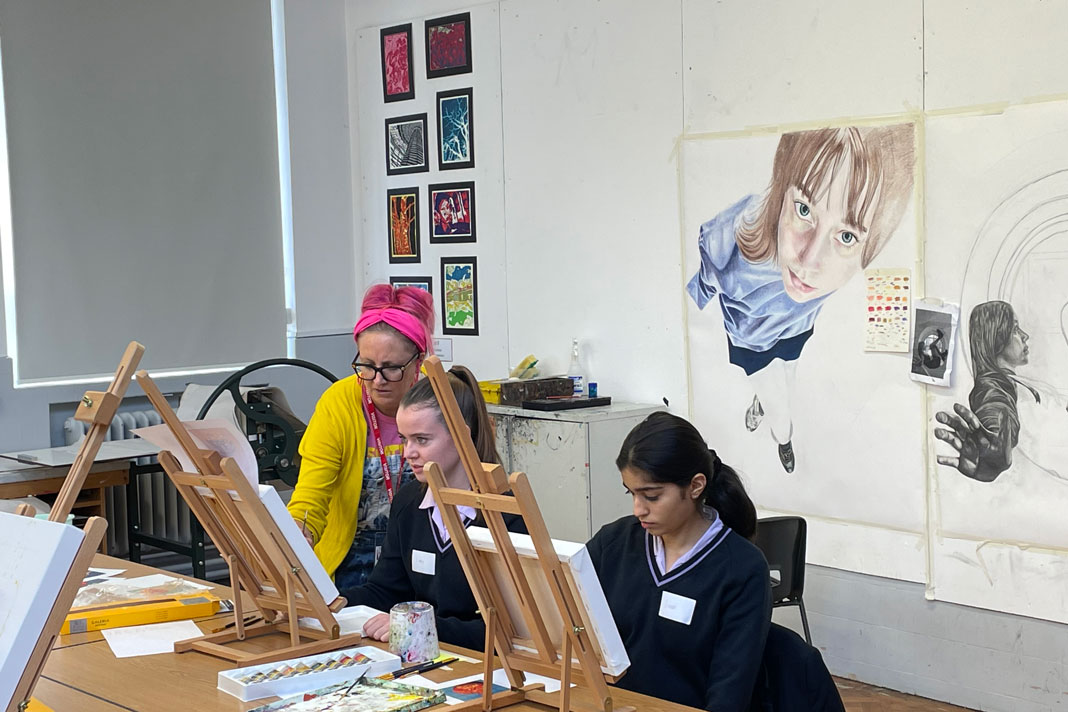
At RMS for Girls in Hertfordshire, there’s a strong Art-based approach to helping students develop their own perspectives and opinions and consider bigger-picture issues. “In the realm of Visual Arts, we possess a rare and vital window into the contemporary world. It is a space where ‘fixed answers’ disintegrate into deeper questions,” says Head of Visual Arts Maxine Nichols.
For example, an art-based exploration into student riots produced dramatic, and deeply personal work, which was then supported by a deep dive into the mechanics of messaging using historical sources as diverse as WWII propaganda posters and modern investigative reports about political incitement.
The Visual Arts department champions ‘slow research’ to encourage students to step away from screens, ask difficult questions and find solutions. There is focus on original sources – be it a museum or the archive in Warner Brothers Studios – helping girls to, as Maxine Nichols puts it: “treat the world as a primary text.”
In the art rooms, students soon learn a ‘wrong’ choice or a failed approach is never a dead end. Across the creative sphere, active and open-ended discussion and teamwork are enabled to stretch a subject. “Unlike subjects with a fixed syllabus, the arts are driven by human intervention,” says Maxine Nichols. She believes one of the most significant benefits of all iterative subjects is that they build resilience – and with visual arts subjects, that creative journey is often on permanent show. “Displaying ‘works in progress’ builds the confidence to be critiqued and the stamina to keep evolving in front of an audience,” she adds.
“Iteration forces a student to question, it is a consistent loop of action and reflection, and this is how a truly unique personal perspective is forged. We aren’t just teaching them to make objects. We are teaching them to be architects of change who can navigate a world that is constantly shifting.”
RMS for Girls rmsforgirls.com
Hurtwood House
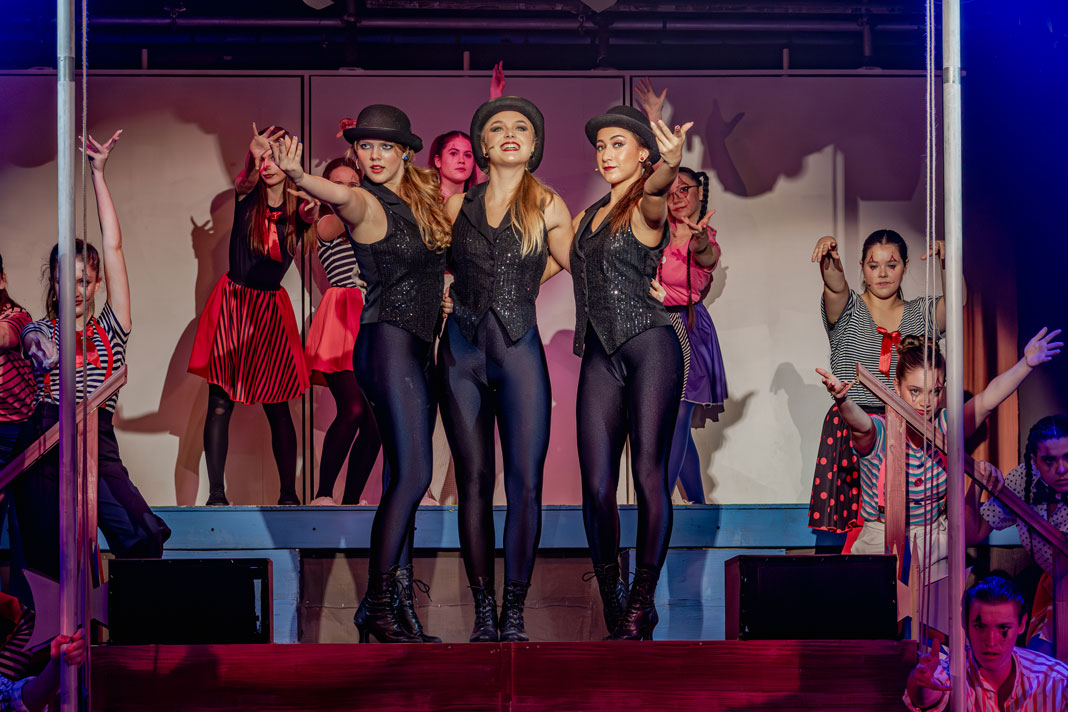
At Hurtwood House in Surrey, Art, Drama and Music taking centre stage for many students, with over 50 professional-quality stage productions a year. All of this is set within a rigorous academic environment, and many students combine arts and sciences subjects at Sixth Form.
Doug Quinn, Head of Performing Arts for many years and a member of Hurtwood’s Senior Management Team, sees huge value in arts subjects – not only for themselves but for what else they bring to students’ understanding of the world. “Art, Drama and Music are inherently iterative and subjective, encouraging students to experiment, reflect and refine their ideas through process rather than aiming for a single ‘correct’ answer. In doing so, students develop critical thinking as they evaluate their choices, consider intention and meaning and learn to see failure as a valuable part of growth.”
He believes the sheer abundance of creative opportunities at Hurtwood help to support student understanding of complexity. “The arts hold a mirror up to nature and society, helping students interpret the world around them and understand their place within it.” He also points to the ways in which arts and humanities subjects face complexity head on, and require students to consider different perspectives, interpretations and contexts.
Many Hurtwood students undertake the EPQ (Extended Project Qualification) alongside their A levels, building invaluable research skills for university and career – and last year every EPQ student was awarded an A*. Head of Life Skills and EPQ Coordinator Jane Collier believes the nature of this qualification encourages students to build essential critical thinking and creative thinking skills by looking beyond the obvious and accessible answers. “We teach students how to conduct academic research using sources such as academic books, articles, journals and archives,” she says.
In previous years, students have visited universities to gain a greater understanding of how to access material and then develop effective research strategies. “We also teach students to conduct primary research, including understanding ethical considerations such as informed consent, anonymity, and responsible data collection,” adds Jane Collier. “Together, these experiences help students develop strong independent research skills and a deeper understanding of how knowledge is gathered, evaluated, and recorded over time.”
Hurtwood House hurtwoodhouse.com
Heathfield School
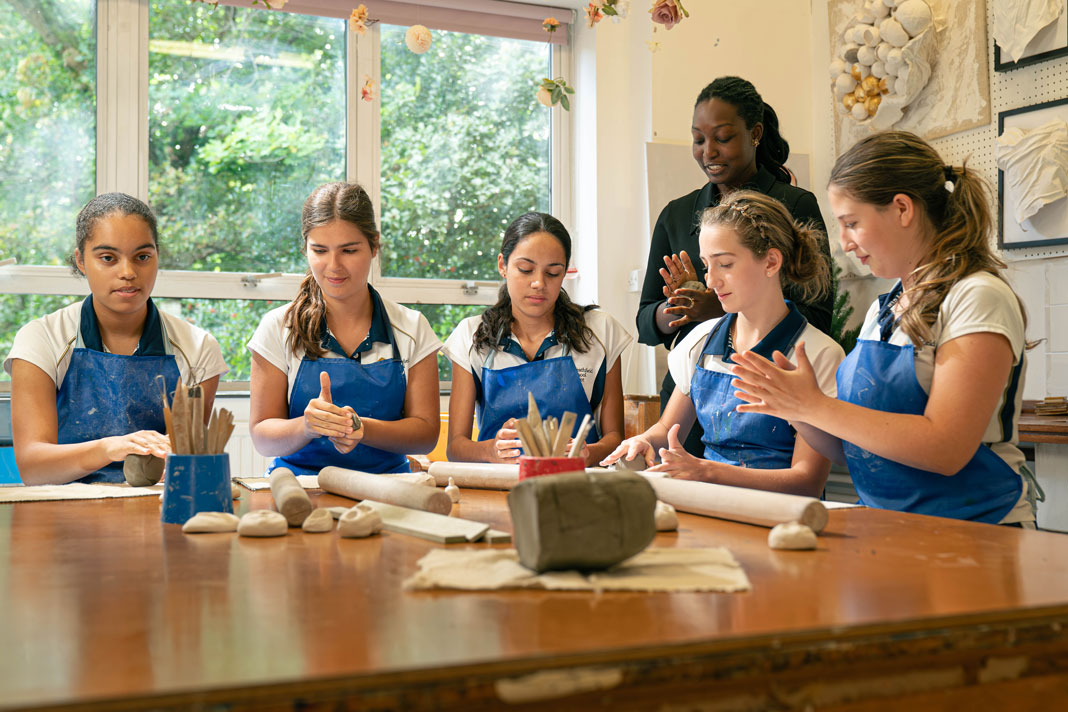
At Heathfield in Ascot, older and newer forms of knowledge gathering sit side by side, especially in the visual arts. This is, in part, because of shifts in the curriculum, with generative AI becoming part of both the GCSE and A-level Art curriculums.
“Tools such as rapid conceptualisation and virtual prototyping enable students to develop ideas quickly while expanding their creativity and craftsmanship,” says Head of Art and Design Angela Farrugia. “We believe that technology and craftsmanship can coexist. Together, they represent a new level of creative power. By learning how to embrace AI as a tool, students can celebrate innovation while honouring the strengths of both traditional practice and technological advancement.”
She sees arts and humanities subjects as a means to open up different perspectives for students, helping them to see ‘grey’ areas and develop an appreciation of often contrasting information or understanding. “Active class, team, and group discussions play an important role in helping students explore ideas from multiple perspectives.
“Through discussion, students learn to articulate their interpretations, listen to others, and thoughtfully challenge or build upon different viewpoints. This process encourages them to think more deeply around a subject, sometimes reaching a shared understanding and, at other times, learning to respectfully agree to differ.”
The school encourages students to recognise that everything they see around them began with a creative idea and an iterative process – from the houses they live in, to the clothes they wear and the vehicle they travel to school in – and in their future they can become part of such a process. “At Heathfield, we believe it is both our privilege and our responsibility to nurture that same spirit of imagination in our students,” adds Angela Farrugia. “We encourage them to see possibilities, to question what already exists, to innovate, and to recognise that they have the power to shape the world around them.”
Heathfield School heathfieldschool.net
St Edward’s Oxford
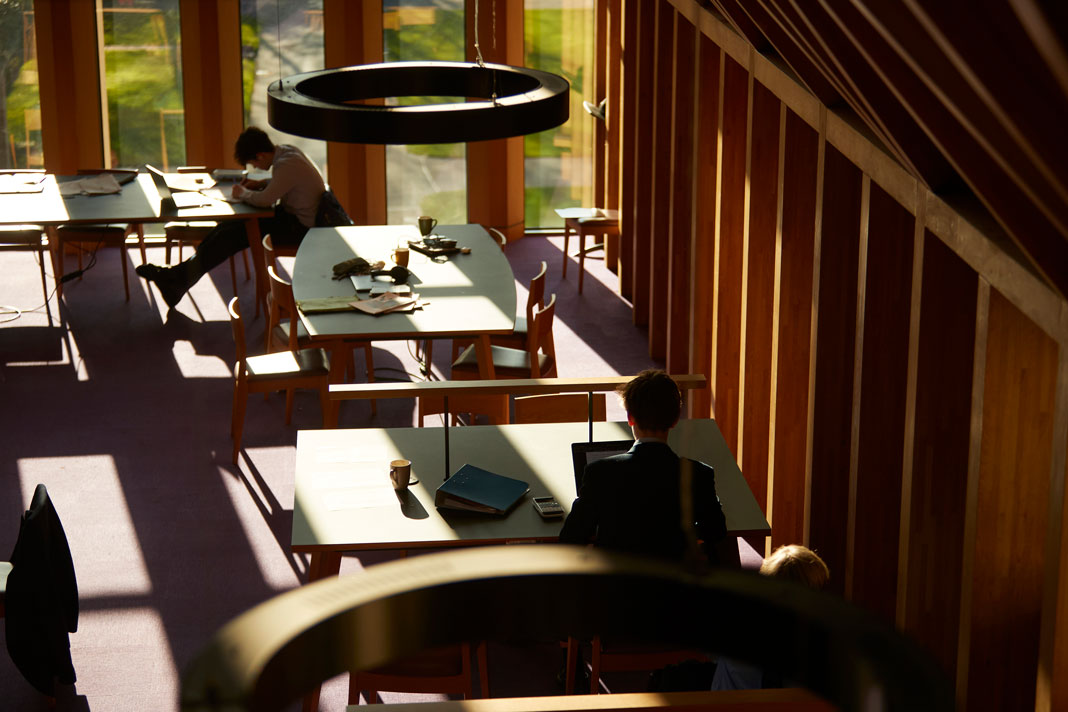
At St Edward’s (Teddies), there’s a robust approach to introducing young people to the idea that not everything they read is true. “We’re teaching complexity and encouraging a culture of independent thought at St Edward’s and therefore responsibility,” says Sub-Warden Academic David Flower.
There’s a particular focus on not relying on the instant answer. “We have a saying ‘no default to device’ that you will hear at Teddies. Just because a knowledge source, such as Google or AI, is instant, it doesn’t mean it is better. In History we use archives, books in the library, original accounts. Sources that you can feel, look at and touch can be more memorable, and give context to the information,” he adds.
“We speak a lot about how learning happens. Sometimes it can be repetitive and feel laborious, learning can feel like hard work, and that’s because it can be, but we know there is still a value in repetition and retrieval amongst other learning methods,” says David Flower. “The danger with instant information is in reading something and believing you know it.”
Learning to disagree respectfully is another lesson taught across arts and humanities subjects. “The best work of this kind has rules and expectations,” says David Flower. “Pupils respond well to learning debating techniques and the Model UN society is a great example of this. How do you successfully put forward an argument you may not agree with? Is there a way to find some common ground between two camps who are largely in disagreement? These skills help our pupils with their critical thinking.”
Critical thinking really comes into play in Sixth Form, when St Edward’s IB Diploma pupils take the Theory of Knowledge (TOK – and it is also invaluable for the EPQ (Extended Project Qualification) at A level. But students are prepared for all this in earlier years. “We explicitly teach students to recognise red flags: bias, misuse of authority, lack of context and selective and manipulated data,” says Paula Díaz Rogado, TOK Coordinator and Spanish teacher. “An activity our students love is when we ask students to ‘prove’ famous wacky conspiracy theories. Counterintuitively, this is a powerful exercise in understanding how data can be manipulated and how confirmation bias operates.”
She adds that TOK teaches students to consider things that aren’t written down and voices that haven’t been heard. “We also highlight that recollections may vary not only because individuals disagree, but because some communities have historically been heard more than others.” Another area highlighted in this strand of the IB Diploma is other means of communicating perspectives. “We, for example, explore anti-war art from Francisco Goya to Pablo Picasso, Banksy and Marina Abramović, asking how artists communicate truths that cannot easily be expressed through data or equations,” says Paula Díaz Rogado.
“Artistic subjects are naturally iterative: students draft, perform, reflect and revise. Through this process, they develop resilience, self-critique and a personal voice. Finally, we encourage students to see the arts not simply as a reflection of talent, but as a way of understanding trauma, collective memory, resistance and, ultimately, what it means to be human.”
St Edward’s Oxford stedwardsoxford.org
Further reading: Humanities in focus
You may also like...