While co-education is on the rise, single sex schools are still thriving. We talk to Ludgrove and More House about the secrets of success
The UK’s independent schools have been in constant evolution but one of the biggest shifts has been to co-education. The arguments are so well known they don’t need reprising, but some schools remain single sex and extremely popular. Simon Barber, Head of Ludgrove School – with the distinction of remaining a full-boarding prep for boys – says the discussion about single sex schools doesn’t feature when prospective parents visit. “It very, very rarely comes into conversation when I’m showing parents around. All they want is the best school for their child.”
Certainly, Ludgrove has star credentials academically, with many of its cohort going on to top seniors – Eton, Harrow, Winchester and Radley figure heavily. The school describes itself as ‘unashamedly ambitious for every boy’. But it talks a lot more about happiness than stellar academics. “There are all sorts of eclectic combinations with schools, but if a school is a really happy place, it’s a great school,” says Simon Barber.
“When I’m showing parents around, all they want is the best school for their child”
“I run a single sex boarding school now, but I’ve also worked in a mixed prep school and a mixed secondary school with boarding, and all three schools are very happy places. So while I’m not evangelical about single sex schools, obviously, I am evangelical about having a happy, thriving, successful school and we happen to be one of those.”
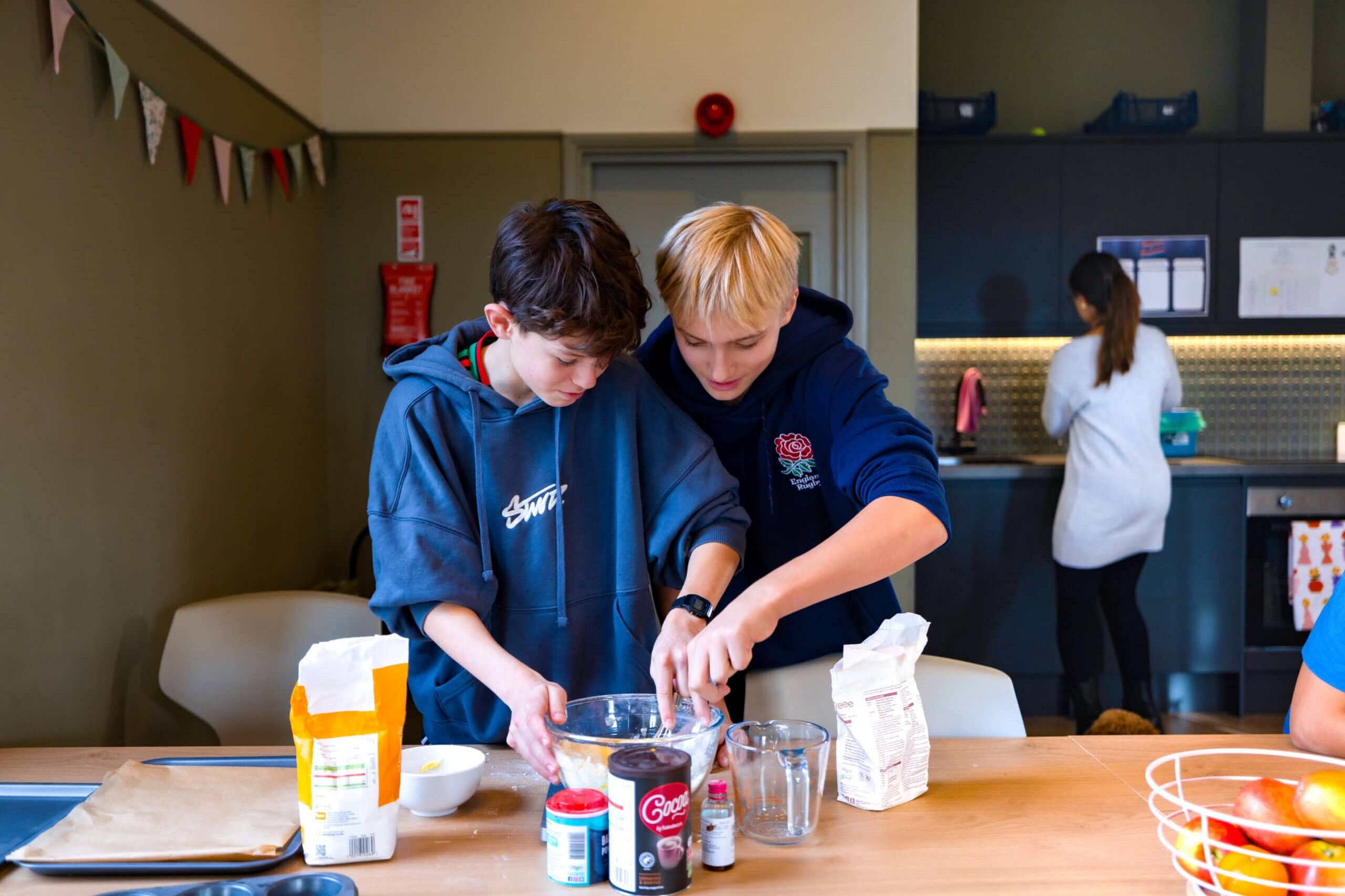
Perhaps in the perennial debate over co-ed and single sex, we forget that society has shifted. “There’s so much interaction between families and socialising in holidays,” says Simon Barber. “Our boys have educational partnerships with girls’ schools and socials with girls’ schools – and it’s as if they’ve been friends for life.” Families visit at weekends and sisters are so firmly part of the school furniture that, Ludgrove even offers a weekend craft club for those who can’t be bothered to get muddy on the sidelines while their brothers play sport. “Sisters are very much part of life here,” says Simon Barber.
There’s a homely feel to Ludgrove. The Head’s wife Sophie Barber heads up pastoral care, while Deputy Head Pastoral Jon Pinchin-Hughes and his wife Tory ensure boarding life is cosy and fun – right down to Sunday’s ‘Pinchin Mix’ tuck shop of penny sweets. Simon Barber believes time and space to grow underpins happy childhoods. “What we do well here is grow characters, grow confidence and hopefully grow creativity,” he says.

Like Ludgrove, More House has USPs that draw families in. First is its location in the heart of Knightsbridge (Harrods is under 200 metres away). It’s super-convenient for transport connections, with girls travelling here from all points in London and beyond. The traditional aesthetics – with wood-panelled walls and traditional red-brick exterior – suggest Edwardian traditions. Not so, for the school was founded in the 1950s. “Essentially, More House was started by a group of parents who wanted a better education for their daughters,” says Head Claire Phelps. So, a forward-thinking approach was embedded from the start. Opening first in Kensington, it moved here in the 1970s.
Another draw is More House’s faith-based foundation. “It’s a Catholic school – very much a progressive Catholic school – so within that we have got an incredibly diverse community,” says Claire Phelps. “We have students of all faiths and no faith at all, although we have a Catholic ethos and values underpinning school life.” It is a small school with individual attention to match – 12-16 is typical and at A level there may be between two and four in a class.
This means teachers know each student’s personality, aspirations and how they learn best. “We have girls applying to Oxford and Cambridge and others who are doing performing arts and digital production in a BTEC – we’ve got that range. Diversity is one of the biggest things we celebrate, and that’s not just in culture but in each student’s aspirations and the journey they are on.”
The makeup of the school is, in her experience, way down the list of parent priorities. “A lot of our parents will look at a group of schools, co-ed and single sex.” While there will always be some who consider that single sex brings academic benefits (for instance, take up of STEM subjects), this sits within a broader set of parameters. “We find that the parents just feel it’s going to be a nurturing and safe environment that will grow self-esteem and confidence – which is particularly important with girls,” she says. “We definitely allow girls to be themselves and not conform, in their subject choices and out of school.”
“Diversity is one of the biggest things we celebrate, and that’s not just culture but the students’ aspirations”
Like Simon Barber, Claire Phelps says the debate around single sex forgets young people’s life experiences. Today, girls and boys mix freely in so many settings. For instance, many More House students make their way here on public transport. “They have brothers, they go to clubs, and at More House we work with boys’ and co-ed schools – for example through our choir.”
A Pre-Senior opened here last September in direct response to parents’ requests. They said they wanted the option to join from KS2 (Year 5), also neatly avoiding the 11+ hurdle that is such a feature in London education (although More House is also a member of the London 11+ Consortium designed to reduce the entry exam burden).
Claire Phelps believes choice remains critical to independent education and, while most parents are open to a variety of options, all seek the same thing. “Happy children – you can see that when you walk around a school,” she says. “That, for me, is the thing that parents buy into. They want to see a community where children are thriving and feel happy.”
Ludgrove School ludgrove.net
More House School morehouse.org.uk
Further reading: How early education helps children build resilience
You may also like...